
Choosing the wrong pre-treatment equipment when deciding on whether to buy a depackager vs a shredder can quietly sabotage an entire anaerobic digestion operation before a single kilowatt of biogas gets produced.
Every food waste stream entering an AD facility carries packaging, plastic, and contamination that must be removed before it reaches the digester tank. The method used to strip that packaging away—whether through aggressive shredding or gentler depackaging—determines everything from biogas yield to equipment lifespan to how much usable material ends up in a landfill instead of a power grid. Organisations like Drycake Twister have spent years studying how these pre-treatment choices ripple through an entire operation, and the data tells a clear story about which approach actually pays off.
Key Takeaways – Depackager vs. Shredder
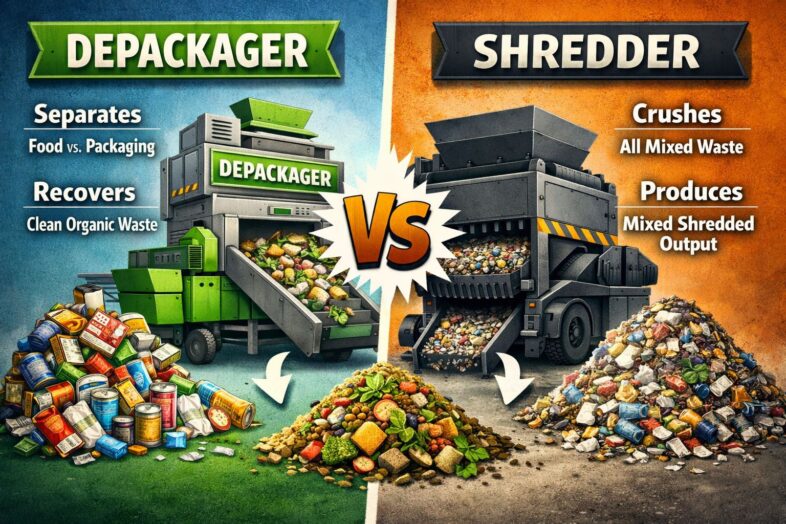
- Depackaging equipment separates organic material from packaging without heavy size reduction, while shredders chop everything together, creating microplastics in the process.
- Shredding can reduce biogas yield by losing organic matter in the rejected materials stream and contaminating the pulp stream with water-logged plastic fragments.
- Modern depackagers like the Twister and Mavitec paddle systems achieve up to 99.5% clean organic output suitable for digester feedstock.
- California's SB 1383 regulation is pushing US facilities nationwide toward cleaner organic waste processing standards, and parallel legislative pressures are also being applied in other nations.
- The right equipment choice can turn a cost centre into a revenue stream through recovered animal feed or higher-purity recyclable plastics—details on exactly how are covered below.
Before diving into equipment specifics, it helps to understand why this decision carries so much financial weight. An anaerobic digestion plant lives or dies on the quality of what goes into its tanks, and the pre-treatment stage is the last checkpoint before that material becomes either fuel or a liability.
Why Depackaging Technology Choice Makes or Breaks Your AD Plant
- The economic driver behind buying any depackaging system comes down to one thing: the value of the organic pulp once it's optimized for water content and purity.
- If plastic isn't removed almost entirely during pre-treatment, it builds up inside the digester tank, causing operational disruption and expensive downtime.
- Heavy fraction waste like sand, grit, and stone often ends up in landfill unless the equipment is designed around a minimum fragmentation philosophy from the start.
Plants that get this stage wrong don't just lose efficiency—they lose money twice. First through reduced biogas output, and second through the added cost of dealing with contaminated rejects that nobody wants to buy. A pulp stream loaded with tiny plastic shards isn't marketable as compost, isn't valuable as animal feed, and can even damage downstream equipment.
That's why the industry has been moving steadily away from brute-force shredding and toward separation technology that treats packaging removal as a precision task rather than a demolition job. The difference between these two philosophies shows up in everything from maintenance schedules to the final price a facility can charge for its outputs.
Operators who've made the switch often describe it less as an equipment upgrade and more as a complete rethink of what “waste processing” should look like. Instead of asking “how do we break this down fast,” the better question becomes “how do we pull this apart cleanly.”
What Shredders Actually Do to Your Organic Waste Stream
Shredders rely on force. Whether it's a hammer mill, a grinder, or a rotating blade system, the goal is the same: reduce everything—food, plastic, cardboard, metal—into smaller pieces fast. That speed comes at a cost that isn't always obvious until the output reaches the digester or the recycling sorter. For a better understanding of the alternative processes, you can explore the depackaging process.
Size reduction equipment doesn't actually add value to the output stream. It consumes more energy than gentler processing techniques while producing material that's harder to sort, harder to recycle, and in many cases, harder to digest efficiently. For more sustainable alternatives, consider exploring sustainability in depackaging methods.
Hammer Mills and Traditional Size Reduction Explained
Hammer mills have been a staple of waste processing for decades, using rapidly spinning hammers to pulverize everything that enters the chamber. The problem is that hammer mills don't discriminate between food waste and the plastic packaging surrounding it—both get shredded together, creating a tangled mix of organic pulp and plastic confetti that's nearly impossible to fully separate afterward.
Why Microplastics Form During Shredding
Every time a blade or hammer strikes plastic packaging, it doesn't just cut it—it fragments it into smaller and smaller pieces, many of which fall below the size threshold needed for mechanical sorting. These microplastics then travel with the organic pulp straight into the digester, or worse, into the final compost or digestate product. When sent to landfill, since no landfill remains sealed forever on a geological timescale, any plastic that escapes proper recycling eventually makes its way into soil and waterways, and ultimately, the ocean. Learn more about the depackaging process for packaging materials.
That's the core argument driving the shift toward depackaging systems that are designed specifically to avoid creating this problem in the first place, rather than trying to filter it out after the damage is done.
The Hidden Costs of High Maintenance and Low Uptime
Operators running shredding and milling equipment for organic waste often report maintenance intervals shorter than typical industry standards, along with high costs for replacing worn components. Blades dull quickly when they're constantly striking a mixed stream of food, plastic, and occasional metal objects. That translates into more downtime, more supervision, and a maintenance budget that eats into whatever savings the equipment was supposed to deliver.
How Modern Depackagers Separate Without Destroying
Depackaging equipment takes a fundamentally different approach. Rather than pulverising everything into uniform small pieces, these systems are engineered to open packaging and release the organic contents while keeping the packaging itself largely intact. That distinction matters enormously once the material reaches the sorting and separation stage.
Rotating Paddles and Flail Systems
The latest depackaging models use a multi-action design built around rotating paddles and flails. These components break open packaging—bags, boxes, shrink wrap—without chopping it into fragments. The empty packaging then gets carried mechanically toward the processing chamber, where it can be ejected as a separate reject stream rather than getting mixed permanently into the organic pulp. Learn more about the depackaging process to understand how these systems work efficiently.
Water and Air Rejection Methods
Once packaging has been opened and organic material released, the two streams need to be physically separated. Most systems accomplish this using water, air, or increasingly, a combination of both.
| Separation Method | How It Works | Typical Result |
|---|---|---|
| Water-based rejection | Organic matter washes through a sieve while packaging is carried away | Clean pulp stream, moist reject |
| Air-based rejection | Lightweight packaging is blown off while heavier organics fall through | Dry separation, lower water use |
| Combined water and air | Uses both mechanisms for maximum purity | Highest organic recovery rates |
The most advanced systems on the market today use both water and air together, squeezing out higher organic recovery rates while keeping the plastic reject stream drier and more valuable for potential recycling. For more insights on achieving high separation rates, explore our detailed guide.
Vortex and Turbo Separation Technology
Beyond standard paddle and flail designs, some manufacturers have introduced water-and-air vortex systems and ballistic separation technology. These novel techniques go a step further by actively removing microplastics that were already present in the incoming waste stream, rather than simply avoiding the creation of new ones. For facilities dealing with waste that's already contaminated with small plastic fragments from previous handling, this capability can make a measurable difference in final digestate quality.
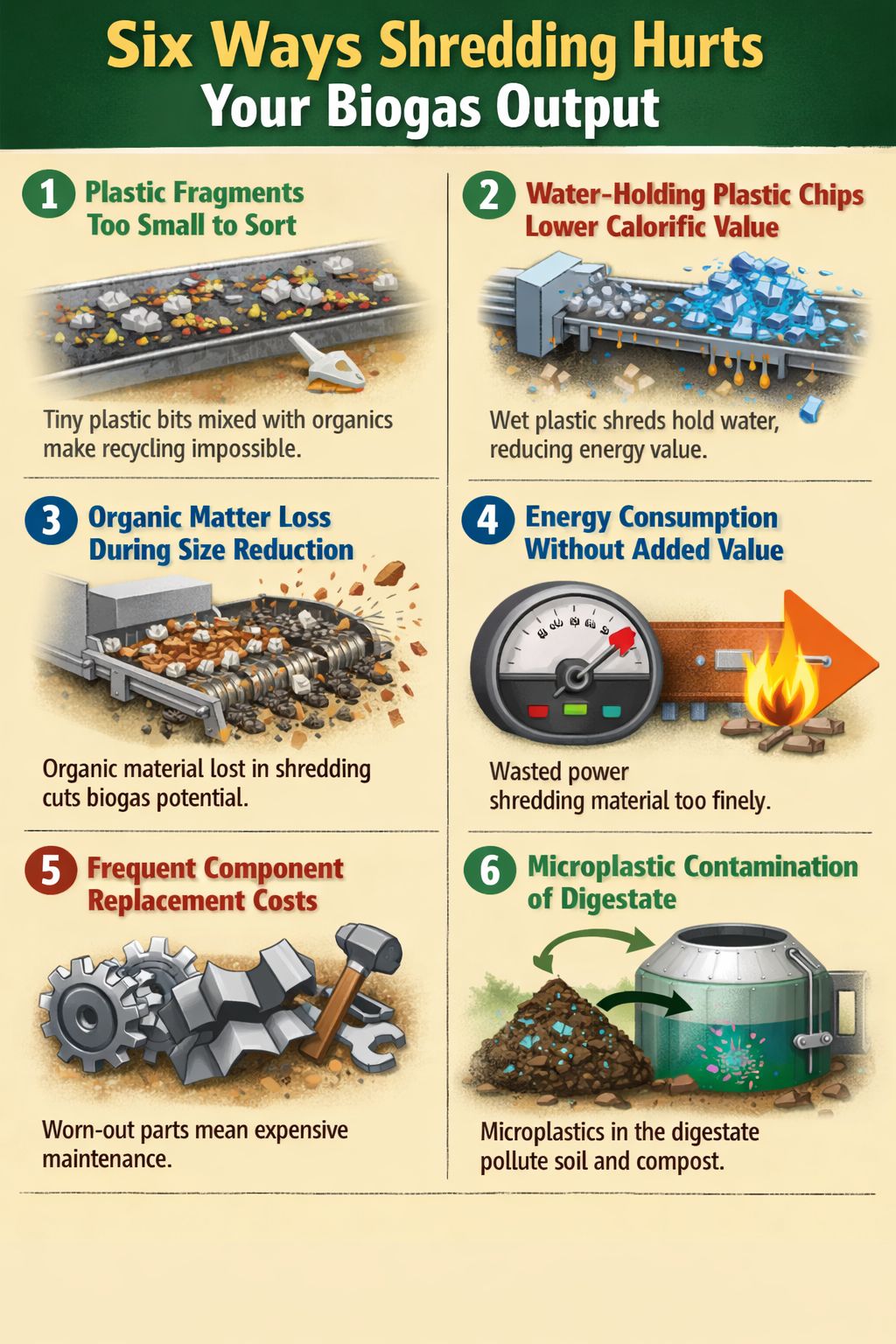
Six Ways Shredding Hurts Your Biogas Output
The damage shredding does to an anaerobic digestion stream isn't limited to one weak point—it stacks up across multiple stages of the process. Here's where the losses actually happen.
- 1. Plastic Fragments Too Small to Sort: Small pieces of plastic with similar specific gravity to organic matter become nearly impossible to sort by polymer type, which kills any chance of recycling that material back into plastic resin.
- 2. Water-Holding Plastic Chips Lower Calorific Value: Tiny plastic shreds have a huge surface area relative to their size, so they absorb and hold water. That moisture reduces calorific value and makes the material unsuitable for energy recovery through incineration.
- 3. Organic Matter Loss During Size Reduction: Every bit of organic content that gets lost or contaminated during shredding is organic content that never makes it into the digester, directly cutting into potential biogas output.
- 4. Energy Consumption Without Added Value: Shredding consumes significant power to pulverise material that didn't need to be broken down that finely in the first place—energy spent without any corresponding boost to output quality.
- 5. Frequent Component Replacement Costs: Blades, hammers, and screens wear out faster when constantly striking mixed waste, driving up part replacement costs and shortening maintenance intervals well below industry norms.
- 6. Microplastic Contamination of Digestate: Once microplastics form, they travel straight through the system into the final digestate, compost, or soil amendment product, where they eventually find their way into the broader environment.
Taken together, these six problems explain why AD facility operators have shifted their capital spending away from shredders and toward gentler separation technology, even when the upfront cost looks similar on paper.
Leading Depackager Models Worth Knowing About
Equipment manufacturers have responded to these shredding problems with a range of depackaging systems, each with its own mechanical approach but a shared goal: separate organics from packaging without turning everything into confetti.
Twister Depackager by Drycake
Drycake's Twister Depackager, developed since 2016 and sold commercially in Europe and Asia starting in December 2021, stands out for using no milling, macerating, chopping, or shredding whatsoever. Its patented design processes food waste that arrives in plastic bags, shrink-wrapped containers, or boxes, all without adding water to the system.
One notable use case involves biscuit factory waste, where out-of-specification production runs are processed through the Twister to separate dry crumbs that go on to become a nutritious cattle feed supplement with real commercial value. That kind of output—clean, dry, and ready for a secondary market—simply isn't achievable with shredding equipment.
Smimo Depackaging Machine by SMICON
SMICON's Smimo machine has been in operation since 2006, discharging organic content through a sieve on one side while packaging exits the other. Its wear parts are designed for easy access and replacement, and a stainless steel version is available for facilities needing extra resistance to foodstuff corrosion. For more insights into the process, explore the depackaging process.
Smimo models come in three standard capacities: Smimo 80, Smimo 120, and Smimo 160, giving facilities flexibility based on throughput needs. For operators wanting an even cleaner organic output, the Smicon BS260 Belt Separator can be added either as a stand-alone depackaging unit or as a purification step after the Smimo.
That modular approach lets smaller facilities start with a base Smimo unit and scale up purification capacity as their output requirements grow, rather than committing to a single massive system from day one.
Mavitec Paddle Depacker
Mavitec's paddle depacker has built a reputation around purity numbers that are hard to ignore: 99.5% clean organic output suitable for feeding directly into biogas installations. Laboratory testing across various food waste types showed less than 0.4% physical impurities remaining in the processed organic stream, a figure that puts it among the cleanest depackaging results on the market and keeps it compliant with current European legislation on organic waste processing.
Dominator Depackager
Originally conceived roughly 30 years ago and based in Gloucestershire, United Kingdom, the Dominator depackager uses a solid steel shaft lined with paddles, driven by a motor that applies mechanical and centrifugal force to strip packaging away from organic content. It's built to handle both dry and wet waste streams, which gives it flexibility across different types of incoming material.
Its long track record means plenty of facilities have years of operational data on this machine, which can be reassuring for operators who want proven reliability over the latest innovation.
Tiger HS640 by Doppstadt US
Doppstadt US, a division of Ecoverse Industries based in Avon, Ohio, built the Tiger HS640 to combine three functions in a single machine: depackaging, shredding, and screening. That hybrid design allows facilities to process solid and liquid fractions together without needing to pre-sort incoming waste.
For operations with limited floor space or budget for multiple separate machines, this all-in-one approach can simplify the pre-treatment line considerably, even though it does retain a shredding component that pure depackaging purists might want to avoid.
Why Plastic Recovery Quality Determines Recycling Value
Getting organics out of the packaging stream is only half the equation. What happens to the plastic afterward determines whether that reject stream becomes a revenue source or just another disposal cost. Learn more about efficient depackaging machines that can enhance separation rates and improve recycling outcomes.
Clean, intact plastic packaging that hasn't been fragmented and soaked in organic residue can often be sorted by polymer type and sold into established recycling markets. Mangled, contaminated plastic shreds almost never can.
Contamination Issues With Small Plastic Pieces
Plastics in a shredded reject stream are frequently contaminated by retained organic content and moisture that clings stubbornly to small and tiny fragments. That contamination makes recycling difficult even when the polymer type is identifiable, because recyclers need relatively clean input to produce usable resin. Once organic residue is baked into a piece of plastic that small, washing it clean becomes economically unfeasible.
Which Systems Achieve Resin-Grade Plastic Output
Depackaging systems that minimize fragmentation—like the Twister, Mavitec, and Smimo—tend to produce a plastic reject stream that's far closer to resin-grade quality because the packaging exits mostly intact rather than shredded into unidentifiable bits. That intact packaging can often be baled and sold to recyclers, turning what used to be a landfill-bound waste stream into a secondary revenue line for the facility. Learn more about the benefits of food waste depackaging equipment.
The Economics Behind Choosing Your Pre-Treatment Equipment
The financial case for depackaging over shredding usually comes down to two revenue streams that shredding simply can't produce.
Organic Pulp Value for Digester Feedstock
The primary economic driver for installing a depackager is the value of the organic pulp once it's optimized for water content and purity. A cleaner pulp stream digests more efficiently, produces more biogas per ton, and reduces the risk of plastic accumulation inside the digester tank that could otherwise cause costly operational disruptions.
Animal Feed Recovery as a Revenue Stream
As shown with the Twister's biscuit factory application, some depackaging systems can recover food waste clean enough to sell as animal feed supplement, turning a disposal cost into an entirely new product line. That kind of secondary revenue stream simply isn't available when organic matter has been shredded together with its plastic packaging.
How California's SB 1383 Is Reshaping Equipment Standards
Regulation is accelerating the shift toward cleaner pre-treatment technology, and California's Short-Lived Climate Pollutant Reduction Strategy, known as SB 1383, is leading that charge. The law took effect in 2022, requiring every jurisdiction in the state to provide organic waste collection services to all residents and businesses.
Organic Waste Collection Requirements Explained
Under SB 1383, jurisdictions must select organic waste collection services designed to produce clean streams of feedstock that can be recycled into high-quality, marketable products, including compost, renewable natural gas, electricity, and paper. That requirement for “clean streams” puts direct pressure on facilities to adopt pre-treatment equipment capable of hitting purity standards that shredders often can't reliably deliver.
What Counts as Organic Waste Under the Law
California's definition of organic waste casts a wide net, covering food, green material, landscape and pruning waste, organic textiles and carpets, lumber, wood, paper products, printing and writing paper, manure, biosolids, digestate, and sludges. That breadth means facilities handling any of these material types need pre-treatment systems versatile enough to process varied waste streams while still meeting the law's purity expectations.
Making the Right Choice for Your Anaerobic Digestion Facility
There's no single correct answer for every operation, but the evidence consistently favors depackaging over shredding wherever biogas yield, digestate quality, and long-term regulatory compliance matter most. Facilities evaluating new pre-treatment equipment should weigh purity rates, maintenance history, and secondary revenue potential just as heavily as sticker price.
Frequently Asked Questions – Depackager vs. Shredder
Does a Depackager Remove All Plastic From Food Waste?
No single machine removes 100% of plastic, but top-performing depackagers like Mavitec report purity levels around 99.5%, leaving less than 0.4% physical impurities in the organic output.
Can Shredders Still Work for Small-Scale AD Operations?
Shredders can technically process small volumes, but the microplastic contamination and organic matter loss they cause tend to undermine biogas yield regardless of facility size.
How Much Water Do Depackaging Systems Typically Use?
It varies by model—some systems like the Twister require no added water at all, while others use water-based rejection methods to separate organics from packaging.
What Happens to the Plastic Rejects After Separation?
Clean, minimally fragmented plastic rejects can often be baled and sold into recycling markets, while heavily contaminated or fragmented plastic typically ends up in landfill.
Are Regulators Moving to Ban Hammer Mill Equipment?
No outright bans exist yet, but regulations like California's SB 1383 are pushing facilities toward cleaner processing standards that hammer mills struggle to meet.